

In the field with Healthy Land & Water’s Sustainable Agriculture team – June 2025
Our Sustainable Agriculture was out across the region in June attending events and visiting landholders. Let’s take a look at what they got up to in the field.
Cattle, Carbon and Sustainability event in the Somerset region
On 10 June, Healthy Land & Water hosted the Cattle, Carbon and Sustainability Workshop in Toogoolawah, bringing together local producers and industry experts to explore practical approaches to carbon management in grazing enterprises.
The workshop featured a line-up of engaging presenters, including Billie Standfield (DPI Beef & Carbon Extension Officer), experienced carbon farmer and advisor Christophe Bur, as well as Healthy Land & Water staff. Together, they unpacked a wide range of topics relevant to graziers navigating the evolving carbon space:
- Understanding the carbon cycle and carbon emissions in agriculture.
- What it means to be carbon neutral at both industry and farm levels.
- Developing a carbon account for a grazing business.
- Practical strategies for managing carbon and emissions on-farm.
- The ins and outs of carbon farming, including methods, opportunities and potential risks.
- Other emerging environmental markets and diversification opportunities.
The presenters drew on real-world examples and their own carbon farming experiences, helping to demystify what can often be a complex and jargon-heavy subject. Participants gained a clearer understanding of how carbon reporting and environmental markets can open doors for their businesses.
Grant Pringle, SEQ Node Extension Officer for Healthy Land & Water, attended the event and shared his reflections:
“One of my key takeaways is that much of what is good for reducing farm level carbon emissions in a grazing enterprise, is well aligned with the existing best management practices for this enterprise type,” Grant said.
Grant also noted that carbon farming and trading carbon credits is underpinned by well-established methods to determine the accrual of credits and trading mechanisms.
“The event helped show that producers can actively engage in carbon markets once they have a sound understanding of the process,” he explained. “Incorporating these opportunities into operations can give landholders an opportunity to diversify their income stream and improve their overall financial resilience.”
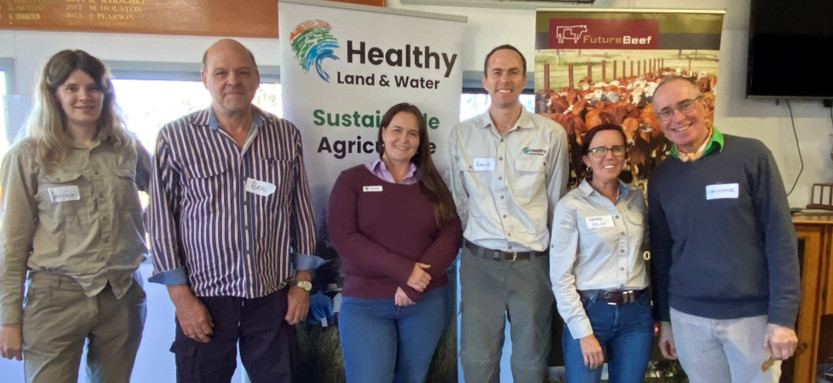
Presenters and some of the participants from the Carbon, Cattle and Sustainability Workshop held at Toogoolawah. Jessica Cook (DETSI), Ben Harms (DETSI), Billie Standfield (DPI), Grant Pringle (Healthy Land & Water), Vanessa Smolders (Healthy Land & Water) & Christophe Bur (grazier and advisor).
Scenic Rim Agricultural Expo
On 19 June, Grant Pringle represented the SQNNSW Innovation Hub at the Scenic Rim Agricultural Expo in Harrisville. This event is designed to bring together producers, industry experts, and the local community.
Grant described the day as a fantastic opportunity to engage with the local community and industry representatives in attendance. Healthy Land & Water and the Drought Hub had a shared stall at the event, nestled between the Boonah District Landcare group and the Queensland Department of Natural Resources. This central location offered attendees an easy, one-stop destination for attendees to get information on all things natural resource related.
While overall attendance was lower than anticipated, Grant noted that the quality of conversations more than made up for it.
“I had some inspiring and meaningful discussions, and it was a great chance to strengthen networks within the community and industry,” Grant shared.
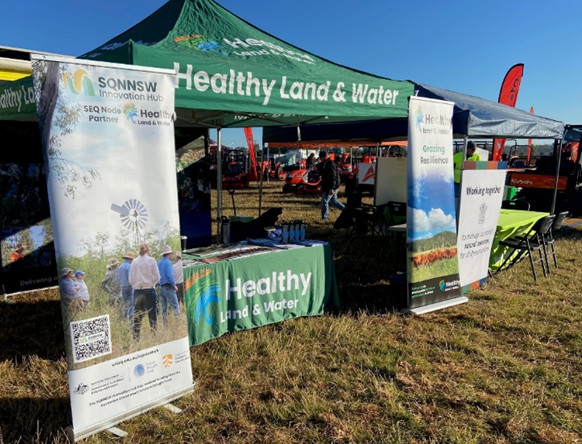
The SQNNSW Innovation Hub stand at the Scenic Rim Agricultural Expo in Harrisville.
Monitoring for winter-active dung beetles
On 11 June, Grant Pringle and Bruce Lord, joined by Rob Young from EcoInsects, headed out on a late-season field trip to track the activity and distribution of the winter-active dung beetle, Onitis caffer.
The trip started in Ravensbourne, proceeded through Crows Nest, to Emu Creek, finishing in the Yarraman area. Along the way, they visited local landholders who had set up ‘traps’ the night before. These comprised of a fresh cow-pat in a bucket designed to attract the beetles overnight.
Due to the prevailing cold and windy conditions, the traps were only moderately effective in collecting beetles, but the field investigations did reveal there were dung beetles present along the entire route. At each stop, the team found evidence of dung beetle activity, including the characteristic small mounds of excavated soil near cow-pats, as well as live specimens of Onitis caffer.
Whilst it was exciting to see that the beetles had maintained and even extended their range within this region, our team observed that overall beetle numbers appeared lower than might typically be expected.
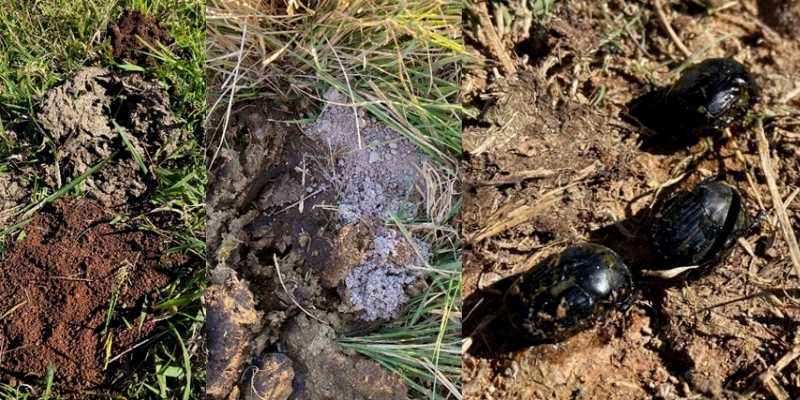
Pictures showing the excavated soil associated with a cow-pat indicating dung beetle activity and a picture of some of the specimens found in the traps or beneath cow-pats in the field.


