

Flood CoP field day insights: Hydrology huddle discussing restoration reflections
Last month, the River Basin Management Society Flood Community of Practice group and the Healthy Land & Water team visited multiple sites around Ipswich and Tarome for a flood resilience field day. The visit explored revegetation successes, community engagement challenges, and hydrology considerations across diverse project sites ranging from early-stage plans to years-old restoration projects, including both council-led public land initiatives and landholder-driven private efforts.
By shifting focus from who led each project to how the measures shaped the landscape, the day highlighted common issues for discussion and the broader ecological impacts of collaborative stewardship.
Read on for some of the key takeaways from the field day.
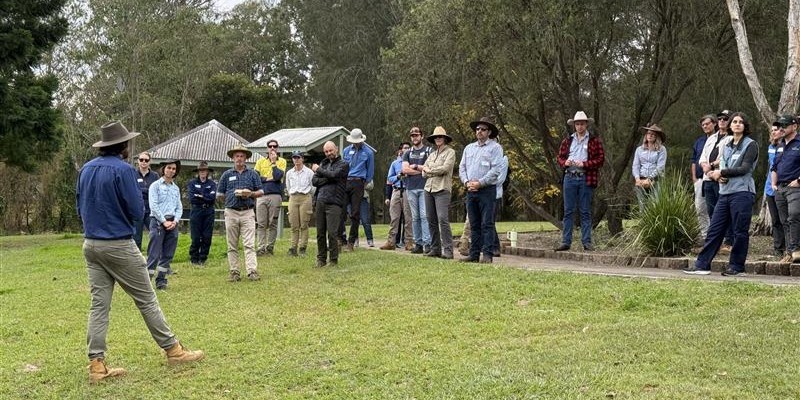
“I’m always trying to learn from other people’s experience, instead of from my own mistakes. It’s so important to create opportunities to see other people's projects, discuss different perspectives and collectively build our understanding of how we can get the best restoration outcomes for our waterways.” |
| – Margie Dickson, Environmental Project Manager – Engineering, Healthy Land & Water. |
Working in river management can be isolating when factors out of human control impact carefully planned works and create issues in every step of the project. This day was a great chance to bring together hydrology experts, river management professionals, and environmental consultants to share similar setbacks, insights from past tests, and brainstorm solutions for projects at different stages. The group was generously hosted by various landholders, offering invaluable firsthand perspectives on their management motivations and day-to-day challenges, reinforcing the importance of community-centred restoration planning.
Some key insights from the day include…
|
|
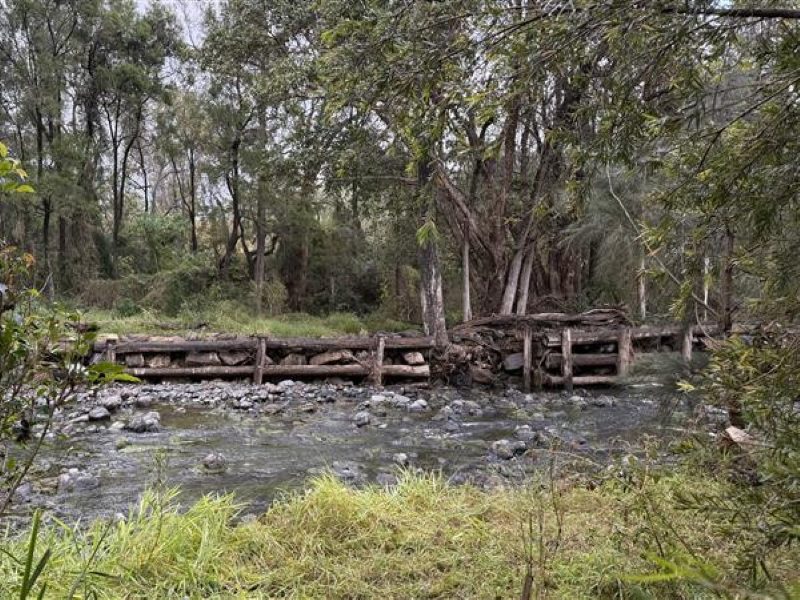
Long-term landholder partnerships are vital for maintaining revegetation sites and ensuring project durability.
The field day emphasised long-term landholder partnerships for successful revegetation, as seen at one site, where log jams installed years ago have transformed into a thriving forest which the landholders have planted and nurtured for over a decade. The restored riparian forest is now mature enough to withstand major floods, and the tree roots replace engineered structures in stabilising the riverbank.
Community-driven efforts, like one site’s multiple volunteer plantings, showed that there’s community appetite and engagement potential, despite facing flood-related setbacks. Highlighting sites that provide community benefit could be a good starting point to increase visibility of restoration works and build a sustained community of landholders and carers in the long run.
|
|
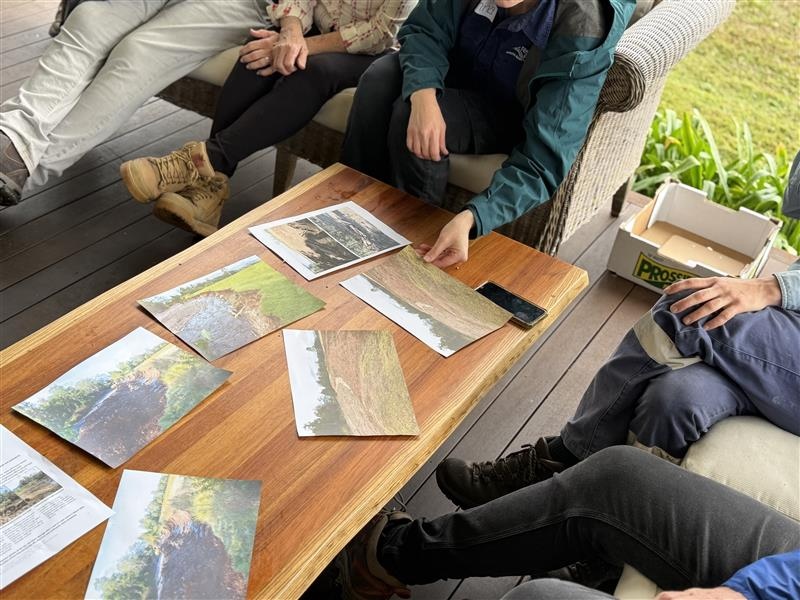
Successful waterway restoration must combine landscape-scape understanding with site-specific detail.
The field day highlighted two very different waterways: a confined section of the Bremer River, where floods rise quickly between high, sloping banks, and the gravelly streams of the Upper Warrill, where high-energy flows from the Great Dividing Range rearrange gravel and change riverbanks with every flood. Understanding how each waterway behaves differently within the landscape allows us to design solutions that harmonise with natural processes to drive recovery and long-term resilience. Each individual site also had local differences like soil type, access, and ecology, which shaped the restoration design.
For example, in one site, the group brainstormed solutions like hydro mulch for sheer eroded cliffs that would be too disruptive to batter down, which showed promise in other similar landscapes. The day emphasised that site-specific assessments were essential to avoid unintended consequences in densely populated areas.
“My key takeaways are the importance of collaboration across practitioners, landholders, government levels, etc. to deliver resilient sites. Every site is different and it’s clear that a copy and paste approach does not work in as dynamic a system as waterways” – Vanessa Durand, Environmental Project Manager, Healthy Land & Water.
|
|

Engaging with community early builds essential foundations of trust and respect.
Early community involvement proved vital. Landholders’ early insights about the local geomorphology and their own habits ensured better planning which ensures the works put in can be sustainably nurtured and maintained.
Starting conversations early also allows for rapidly developing challenges like fire ants and soil loss to be factored into flexible, science-backed solutions while the project progresses.
Throughout the day, one learning was reiterated by landholders and project managers alike: Lasting success hinges on combining expertise with local collaboration.
"Community and landholder involvement throughout all phases of the project, especially early on, is critical to project success." – Ross Bigwood, Business Development Manager, Healthy Land & Water.
|
|

Days like these are made possible by our wonderful community of passionate landholders, and reinforce the power of collaboration among dedicated river stewards.
Special thanks to hosts Piet Filet from the FloodCoP for hosting, Nicole Wheeler from Streamology, Jack McCann from Ipswich City Council, Nat Parker from Airborn Insight, and our own Margie Dickson for presenting on the day. Chamantha Athapaththu, and Louis North from River Basin Management Society for organising, and Adriana Sanchez-Rosas and Michal Krawczyk for capturing the day.
Want to know more? Read more about the FloodCoP field day here: https://floodcop.com.au/2025/08/01/field-trip-recap-waterway-restoration-in-action-lessons-from-the-bremer-warril-catchments/


